

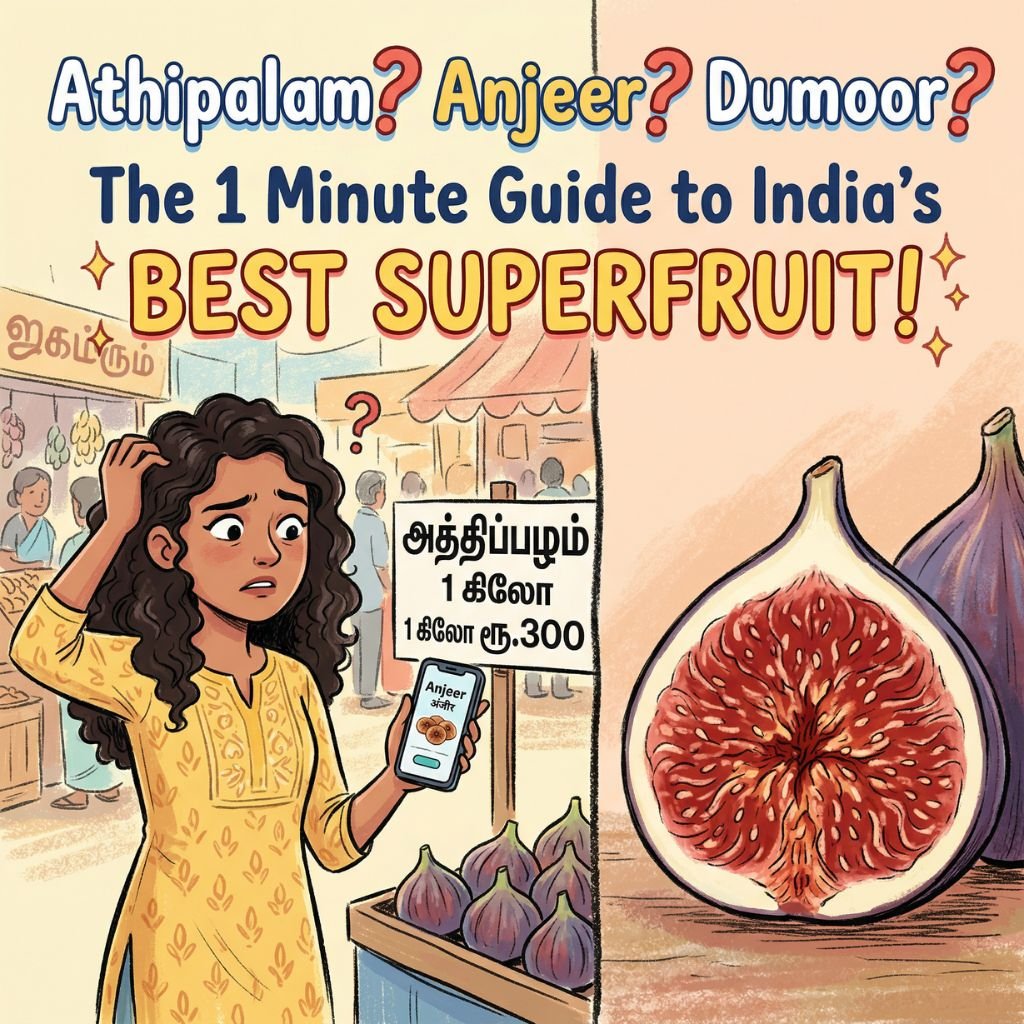
Post Highlights
- One Fruit, Many Names: Athipalam is simply the Tamil word for Figs, known as Anjeer in Hindi, Dumoor in Bengali, and Athi Pallu in Telugu.
- Nutritional Powerhouse: Just two dried pieces offer nearly 2 milligrams of iron, making it the perfect natural supplement for young children and pregnant women.
- Easy Daily Habit: Soaking this fruit overnight removes phytic acid, turning it into a fast, cheap morning remedy for constipation and low energy.
- Budget-Friendly: Buying dried Athipalam in bulk saves families thousands of rupees a year compared to imported berries and synthetic vitamin gummies.
Navigating an Indian grocery market or a quick-commerce app like Zepto can feel like taking a language test. You read a health blog recommending “Figs” for your toddler’s digestion, but your local vendor only stares blankly at that word. You end up buying expensive, imported prunes simply because the packaging is in English.
Meet Shankaran Pillai, a 32-year-old software engineer who recently relocated from Delhi to Chennai with his young family. His six-year-old daughter was struggling with low hemoglobin, and their pediatrician recommended adding fresh “Anjeer” to her diet. Shankaran searched multiple apps and local markets but found absolutely nothing matching that name.
A helpful elderly vendor finally noticed Shankaran’s confusion, looked at a picture on his smartphone, and smiled. The vendor handed him a box of fresh, purple-green fruits and said, “Sir, you are looking for Athipalam.” This simple translation barrier prevents millions of young parents from accessing one of India’s most powerful native superfoods. Here is exactly what this fruit is, how to identify it, and why your family needs it.
What is Athipalam exactly?
Athipalam is the Tamil name for the fig fruit, scientifically categorized as Ficus carica India, which grows extensively across the subcontinent and the Mediterranean. It is a unique tear-shaped fruit filled with hundreds of tiny, crunchy seeds housed inside a sweet, chewy flesh. Unlike most fruits, the flowers of the Anjeer plant actually bloom inside the pod, maturing into the fruit we eventually eat.
In the Indian market, you will find this fruit in two distinct forms. The fresh version is highly perishable, soft, and usually available only during specific late-summer or monsoon windows. The dried version, which resembles a flat, brown disc with a hole in the center, is available year-round in every dry fruit shop.
Drying the fruit removes its high water content, concentrating its sugars, minerals, and vitamins. This is why most Ayurvedic and traditional health remedies specifically call for the dried version of the fruit rather than the fresh one.
What does Athipalam mean across different Indian states?
Athipalam translates directly to “Fig” in English, “Anjeer” in Hindi, and “Dumoor” in Bengali. Because India has vast linguistic diversity, the exact same fruit is sold under entirely different labels depending on which state border you cross.
When Shankaran Pillai learned this, he realized he had been overpaying for “exotic” packaged figs online. By learning the local name, he started buying fresh stock directly from the Chennai Koyambedu market at a fraction of the cost.
Understanding regional translations ensures you never get overcharged by fancy supermarkets. Below is the definitive translation table that will help you identify this superfood anywhere in the country.
| Language | Regional Name for Fig | Common Usage Format |
| English | Fig | Fresh / Dried |
| Hindi / Marathi | Anjeer | Mostly Dried |
| Tamil | Athipalam | Fresh / Dried |
| Telugu | Athi Pallu | Fresh / Dried |
| Malayalam | Atti Pazham | Fresh / Dried |
| Kannada | Anjura | Mostly Dried |
| Bengali | Dumoor | Cooked as vegetable / Fresh |
What is the nutritional value of this fruit?
A standard 100-gram serving of dried Athipalam delivers 9.8 grams of dietary fiber, 249 calories, and a massive 680 milligrams of potassium. It acts as a natural multivitamin, heavily packed with calcium, magnesium, and iron.
For young parents, this nutritional profile is a massive advantage. Children notoriously refuse to eat leafy greens like spinach, which leads to frequent constipation and iron deficiency. Replacing processed chocolate snacks with a naturally sweet piece of Athipalam provides the exact same iron content without the dinner-table tantrums.
Furthermore, the high calcium content supports rapid bone development in growing kids. Two pieces of dried fig contain roughly 65 milligrams of calcium, rivaling the benefits of a small glass of milk.
How do you use Athipalam in daily life?
You can use Athipalam daily by soaking two dried pieces in a glass of water overnight and eating them first thing in the morning. This simple process breaks down the complex fibers and neutralizes phytic acid, making the nutrients instantly bioavailable to your body.
Step 1: The Overnight Soak
Shankaran Pillai prepares this for his daughter every single night before bed. He takes two dried figs, rinses them under tap water to remove dust, and drops them into a small clay or glass bowl filled with drinking water. Leaving them at room temperature for 8 hours allows the fruit to swell and soften.
Step 2: The Morning Routine
At 7 AM, the fruit becomes plump, jelly-like, and extremely easy to chew. Shankaran makes sure his daughter eats the fruit on an empty stomach before her breakfast milk. This ensures maximum iron absorption into her bloodstream without interference from other heavy foods.
Step 3: Utilizing the Leftover Water
Do not throw away the water used for soaking the fruit. During the night, essential water-soluble vitamins and potassium leach into the liquid. Drinking this slightly sweet, brown-tinted water provides an immediate electrolyte boost to start the day.
[Also View: How to Eat Soaked Anjeer for Maximum Iron & Digestion Benefits]
Why is the Anjeer plant so important for India?
The Anjeer plant is crucial to the Indian agricultural landscape because it is highly drought-resistant and thrives in rocky, dry terrains like Maharashtra and Karnataka. It requires minimal water compared to cash crops like sugarcane or rice.
This resilience makes it an incredibly sustainable and profitable crop for local farmers. When you buy locally grown Athipalam, you are directly supporting farming communities in arid regions. You also reduce the massive carbon footprint associated with flying imported berries and prunes from California or Europe.
Commercially, the Pune region produces some of the highest quality figs in the country, completely eliminating the need for expensive imports. A 500-gram pack of premium Indian-grown dried figs costs around ₹400, making it accessible for the average middle-class pantry.
Are there any risks to eating too much?
Yes, eating more than five pieces of dried Athipalam in a single day can lead to severe bloating, diarrhea, and stomach cramps. The fruit contains a massive amount of dietary fiber, and introducing too much fiber too quickly overwhelms your digestive tract.
Shankaran Pillai made this exact mistake during his first week of buying the fruit. Thinking “more is better” for his family’s health, he allowed his daughter to eat six dried pieces as an evening snack. The resulting stomach ache meant a sleepless night for the whole house.
Always treat this superfood as a supplement, not a primary snack. Stick to the strict limit of two to three pieces per day for adults, and one to two pieces for children under ten years old.
FAQ’s
Yes, Athipalam and Anjeer are the exact same fruit. Athipalam is the Tamil word used in South India, while Anjeer is the Hindi word widely used across North and West India to describe the fig.
Yes, consuming Athipalam daily is highly beneficial for your health. Eating 2 soaked dried pieces every morning safely improves digestion, boosts iron levels, and provides steady energy without any negative side effects.
In Bengal, raw green figs (Dumoor) are frequently chopped and cooked as a savory vegetable curry rather than eaten as a sweet fruit. This traditional preparation retains the high fiber and iron content while making it a staple, diabetes-friendly side dish for lunch.